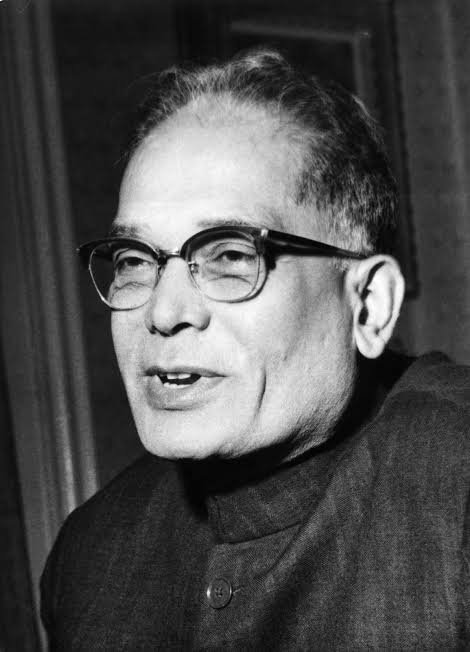
Jayaprakash Narayan, revered across India as Lok Nayak (People’s Leader), was born on October 11, 1902, in the remote village of Sitabdiara. His birthplace sits along the shifting river borders of Saran district in Bihar. His father, Harsu Dayal, worked as a minor subordinate official in the state canal department, while his mother, Phul Rani Devi, managed their traditional, middle-class household. Narayan relocated to Patna at age nine to attend the Patna Collegiate School, where he excelled as a deeply introspective student. Heavily influenced by Nationalist speeches, he abandoned his formal British-funded college education just days before his final examinations to join the anti-colonial Non-Cooperation Movement. In 1922, he traveled to the United States on a cargo ship, working manual jobs as a mechanic and fruit packer to fund his Master’s degree in Sociology at the University of Wisconsin.
Narayan fought prominently in India’s independence movement alongside Mahatma Gandhi. However, his defining battle against domestic corruption emerged decades later in the post-independence era. By the early 1970s, he grew deeply disillusioned with rapid moral decay, administrative bribery, and rising autocracy within India’s political establishment. In 1974, he came out of retirement to spearhead the historic Bihar Movement, galvanized by student protests against inflation and misrule. Narayan elevated this regional unrest into a national campaign for Sampoorna Kranti (Total Revolution). He argued that true democracy could not function if public institutions were corrupted by money and centralized power. He demanded deep electoral reforms and absolute transparency to ensure governance remained answerable to ordinary citizens.
Defending the Pillars of Democracy
When the central government imposed a national Emergency in 1975 to squash political dissent, Narayan was promptly imprisoned. From his cell, he became the unyielding symbol of democratic defiance for millions of citizens. His mobilization successfully united fragmented opposition parties to defeat a seemingly invincible regime in the subsequent general elections. This historic victory demonstrated the raw power of collective public will over institutional decay.
Narayan remains central to modern political philosophy because he decoupled patriotism from blind obedience to state power. Scholars consistently point to the JP Movement as India’s ultimate civic primer on how ordinary citizens must actively monitor public officials. His legacy reminds Bihar that when formal checks and balances fail, transparency must be actively defended from the ground up to prevent the rise of systemic inequality.
For a comprehensive historical look at his ideological journey, scholar Bimal Prasad and Sujata Prasad’s authoritative biography, The Dream of Revolution: A Biography of Jayaprakash Narayan, offers an unmatched analysis of his life. The book details how a young boy from Sitabdiara grew to shake the foundations of India’s political establishment. Understanding JP’s philosophies through serious literature ensures that his principles of total accountability remain a living blueprint for governance, rather than fading into a distant historical memory.