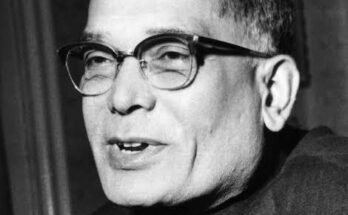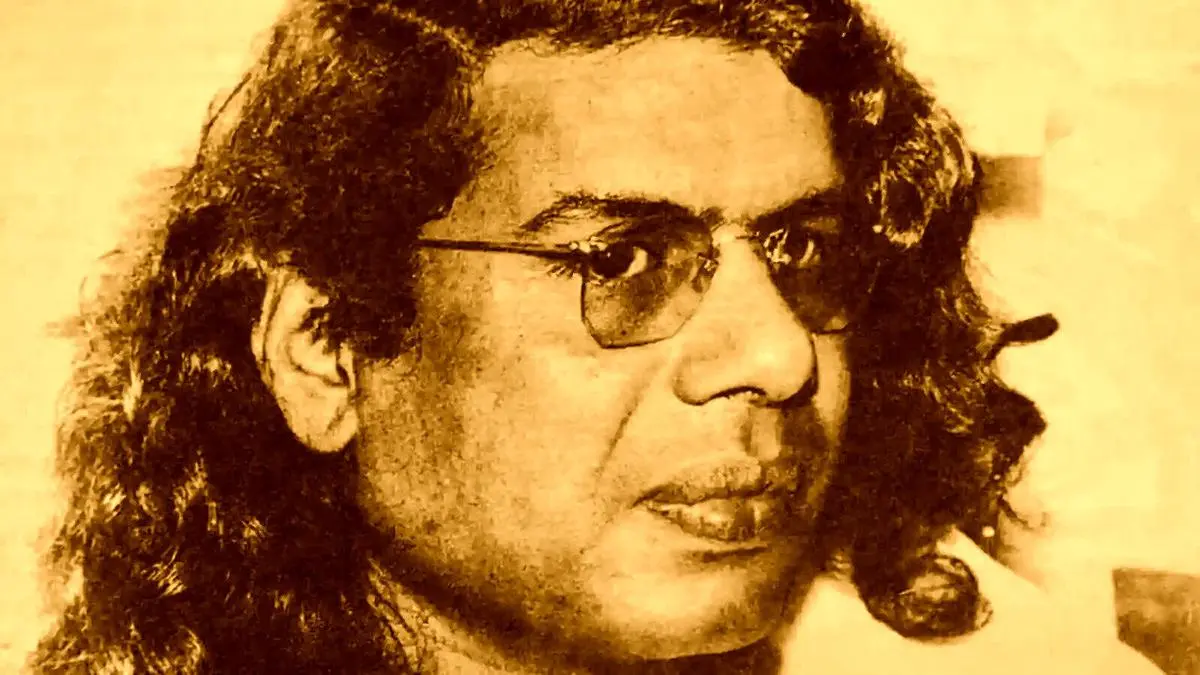
Phanishwar Nath Renu remains one of the most consequential figures in twentieth-century Hindi literature, celebrated for fundamentally shifting the focus of modern prose back to the rural landscape. Before his breakthrough, mainstream Hindi fiction largely mirrored urban complexities or focused on affluent protagonists, often written in a highly formalized, academic language. Renu radically disrupted this convention by centering his narratives on the lives of impoverished farmers and marginalized communities in small villages. His masterpiece, the famous novel Maila Anchal, achieved instant acclaim for its unvarnished portrayal of rural life. Rather than sanitized folklore, he exposed the intricate layers of village politics, caste struggles, and economic deprivation, balancing these hardships with a vivid celebration of local dialects, folk music, and seasonal festivals.
Born on March 4, 1921, in the small village of Aurahee Hingna in Bihar’s Purnia district, Renu was deeply anchored in the geography he would later immortalize. His parents were Shilanath Mandal and Pano Devi. His family belonged to a middle-class farming background, and his father was an active freedom fighter with a profound appreciation for art and cultural expression. This progressive household environment provided Renu with early encouragement to pursue an education and think independently. He received his early education first in Araria and then in Forbesganj. After passing his matriculation examination, he was sent to Banaras for higher education, though he did not stay there long and returned to Bihar. He later enrolled in a college in Bhagalpur, where he became deeply entangled in active politics and fell under the heavy influence of the socialist movement. Growing up immersed in the rural hinterland gave him a native command of village customs and vernacular speech. When he began writing, he rejected the formal, standardized Hindi favored by the urban literary elite, choosing instead to weave local dialects directly into his prose to capture the authentic rhythm of rural conversation.
This unconventional linguistic style initially triggered a severe professional struggle for recognition within the Hindi literary sphere. At the time of its publication in 1954, traditional critics did not accept his work easily. The orthodox Hindi establishment frequently dismissed his reliance on regional sub-dialects, arguing that it corrupted the purity of formal grammar. Renu faced years of marginalization, fighting against rigid editorial standards to prove that the vernacular of ordinary citizens possessed profound literary value. While regional tendencies had been visible since the era of Premchand, it was through Renu’s work that the genre reached its absolute maturity. It took nearly a decade for contemporary scholars to concede that his technique had birthed an entirely new, highly influential genre known as Anchalik Upanyas, forever changing the boundaries of Hindi writing.
Renu’s literary philosophy was inseparable from his intense political activism. He firmly believed that a writer must be an active participant in societal change, not merely an observer. In 1942, he joined the Quit India Movement against British colonial rule, an effort that resulted in his imprisonment and gave him firsthand insight into human resilience under oppression. Because his birthplace was located near the Indo-Nepal border, he also developed a natural interest in the armed revolution of Nepal. When the struggle erupted against the autocratic monarchy of Nepal in 1950, Renu joined the rebel army as a revolutionary. Remarkably, he went on to serve as the first Director General of Nepal Radio, which was operated by the rebels. For a long time, he also remained an active member of the Communist Party.
A major shift occurred between 1952 and 1953, when Renu suffered from a prolonged and severe illness. This physical confinement forced him to step back from active political organizing and channel his energy entirely into creative writing. Yet, his fierce political conscience never faded; decades later, he fiercely opposed the imposition of the Emergency in India. For his monumental contributions to literature, the Government of India honored him with the Padma Shri award, and a commemorative postage stamp was later issued in his honor.
While Maila Anchal remains his most defining work, Renu’s exploration of post-independence rural India expanded across several significant novels, short stories, essays, and memoirs. Each piece captured the psychological and social transformations of post-independence India with sharp, journalistic precision. His other notable novels include Parti Parikatha, which delves into land reforms and environmental challenges; Deerghatapa, a sharp narrative detailing institutional corruption; Juloos, a sensitive portrayal of East Bengali refugees trying to resettle in rural Bihar; Kitne Chaurahe; and Paltu Babu Road.
His short story Mare Gaye Gulfam follows the unfulfilled, poignant bond between a naive bullock cart driver and a traveling theater dancer. The cinematic adaptation won top national awards and remains a defining masterpiece of realist Indian cinema. His critical story collections include Thumri, Ek Aadim Ratri Ki Mehak, Agnikhor, and Achhe Aadmi, alongside highly anthologized individual stories like Lal Paan Ki Begum, Panchlight, Thesh, and Samvadiya. Renu was also a pioneer of Hindi literary journalism, producing non-fiction volumes such as Rinjal-Dhanjal, Nepali Krantikatha, Van Tulsi Ki Gandh, and Atma Parichay.
His ability to extract deep poetry from ordinary existence is precisely why modern academia continues to re-evaluate his impact on Hindi letters. Rajiv Ranjan, a PhD graduate from Jawaharlal Nehru University who focuses on twentieth-century Hindi literature, observes that while the mainstream establishment largely ignored or minimized Renu’s contributions during his lifetime, his cultural footprint has expanded significantly over time. Ranjan notes that as contemporary readers grow increasingly distant from agrarian roots, Renu’s literature is experiencing a major resurgence, drawing a new generation of urban readers and academic researchers eager to understand the historical realities of rural India.
Through a prolific body of work cut short by his death on April 11, 1977, Renu demonstrated that enduring literature does not require grand, urban settings or elite protagonists. A compelling narrative could be found entirely within a mud hut or a bustling village market struggling with poverty and societal changes. Nearly five decades after his passing in Purnia, his novels remain staples of university syllabi across the subcontinent. By giving a sophisticated literary voice to millions of rural citizens who had been systematically ignored by mainstream publishing, Renu did not merely document history; he permanently expanded the linguistic and thematic boundaries of Hindi literature.